
The Moroccan kaftan, from court robe to wedding night

A kaftan is a long robe, open or closed at the front, worn by Moroccan women for every celebration that matters. Its shape is simple; its value lies in the handwork that edges, closes and decorates it.
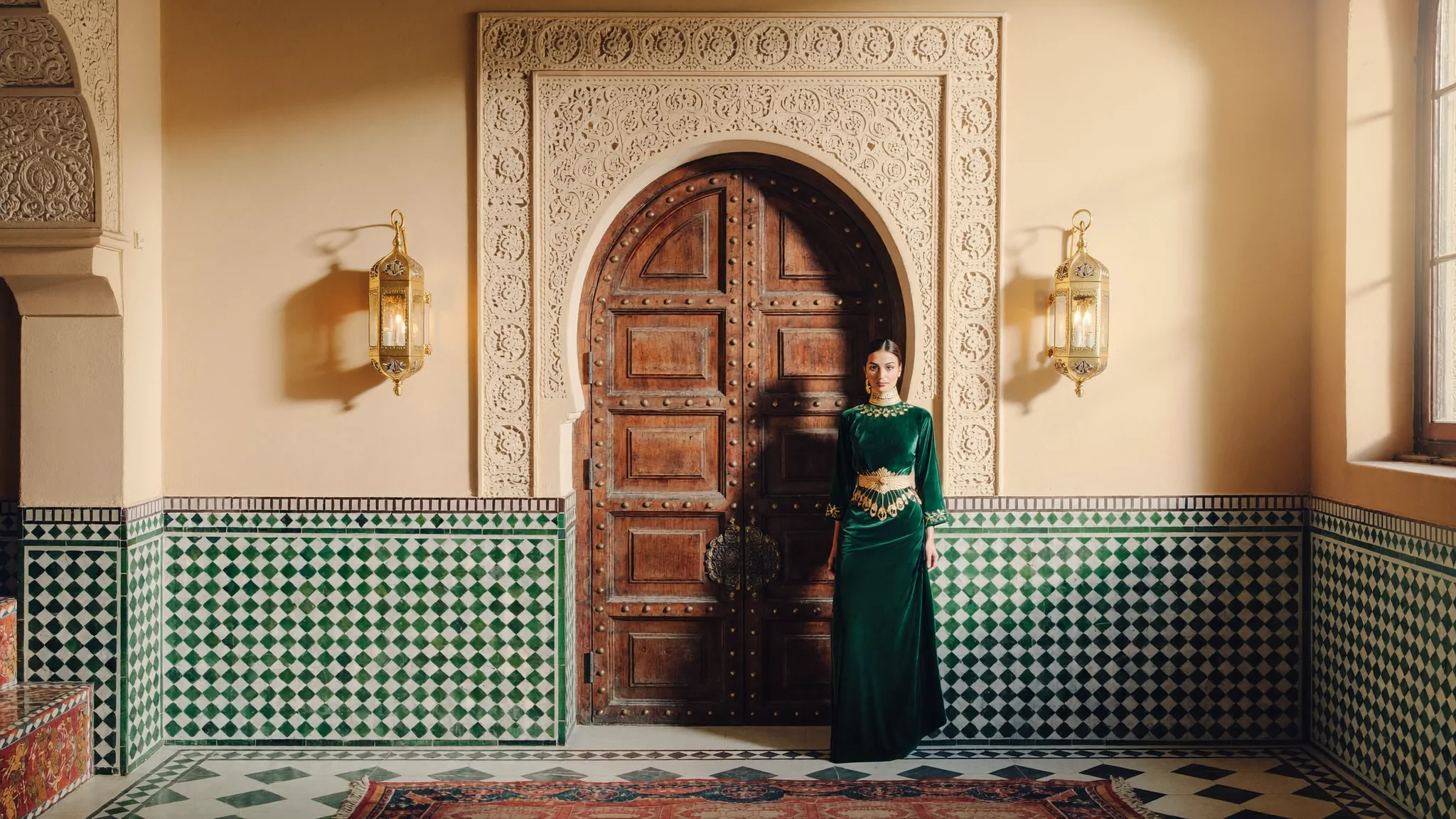
Five centuries in brief
- 16th century
By the Saadian era the kaftan is established at the Moroccan court as a robe of rank, cut from silks and brocades.
- 17th – 19th centuries
City workshops in Fès, Rabat, Salé and Tétouan give the kaftan local accents that are still recognisable today.
- 20th century
The takchita — a dress worn under a sheer overdress and cinched with a belt — becomes the dress of Moroccan weddings, and designers bring the kaftan to the runway.
- Today
The kaftan is worn from Casablanca to Paris, Dubai and Montréal. The hand crafts — sfifa, aakad, tarz — remain the measure of a good piece.
Three cities, three hands
Fassi
From Fès: long, straight lines and restraint. Tarz fassi is a fine counted embroidery, often in a single colour, that reads the same on both sides of the cloth.
Rbati
From Rabat: generous sleeves, bold colour and dense floral tarz rbati worked in silk thread.
Tétouani
From Tétouan: an Andalusian line, fitted bodices and gold-thread embroidery at every edge.
Anatomy of a kaftan
- Tahtia
- The under-dress of a takchita.
- Dfina
- The overdress, often sheer or lighter, laid over the tahtia.
- Sfifa
- Braided trim made by hand and stitched along every seam and opening.
- Aakad
- Knotted buttons, tied one by one, closing the front.
- Mdamma
- The belt that cinches the waist — gilt metal, embroidered fabric or both.
- Tarz
- Embroidery; each city has its own.
- Randa
- A fine needle-lace edging used at necklines and cuffs.
The wedding night
At a Moroccan wedding the bride changes outfits several times through the night, dressed and adorned by the negafa. Kaftans and takchitas carry the regional and family stories of the evening — which is why renting a couture piece for one night has become as natural as buying one to keep.