
The Moroccan kaftan guide

Clear answers about Moroccan kaftans and takchitas: what they are, how they are made, how to choose a size, and how buying and renting work at Hiba.
Updated:
Questions and answers
What is a Moroccan kaftan?
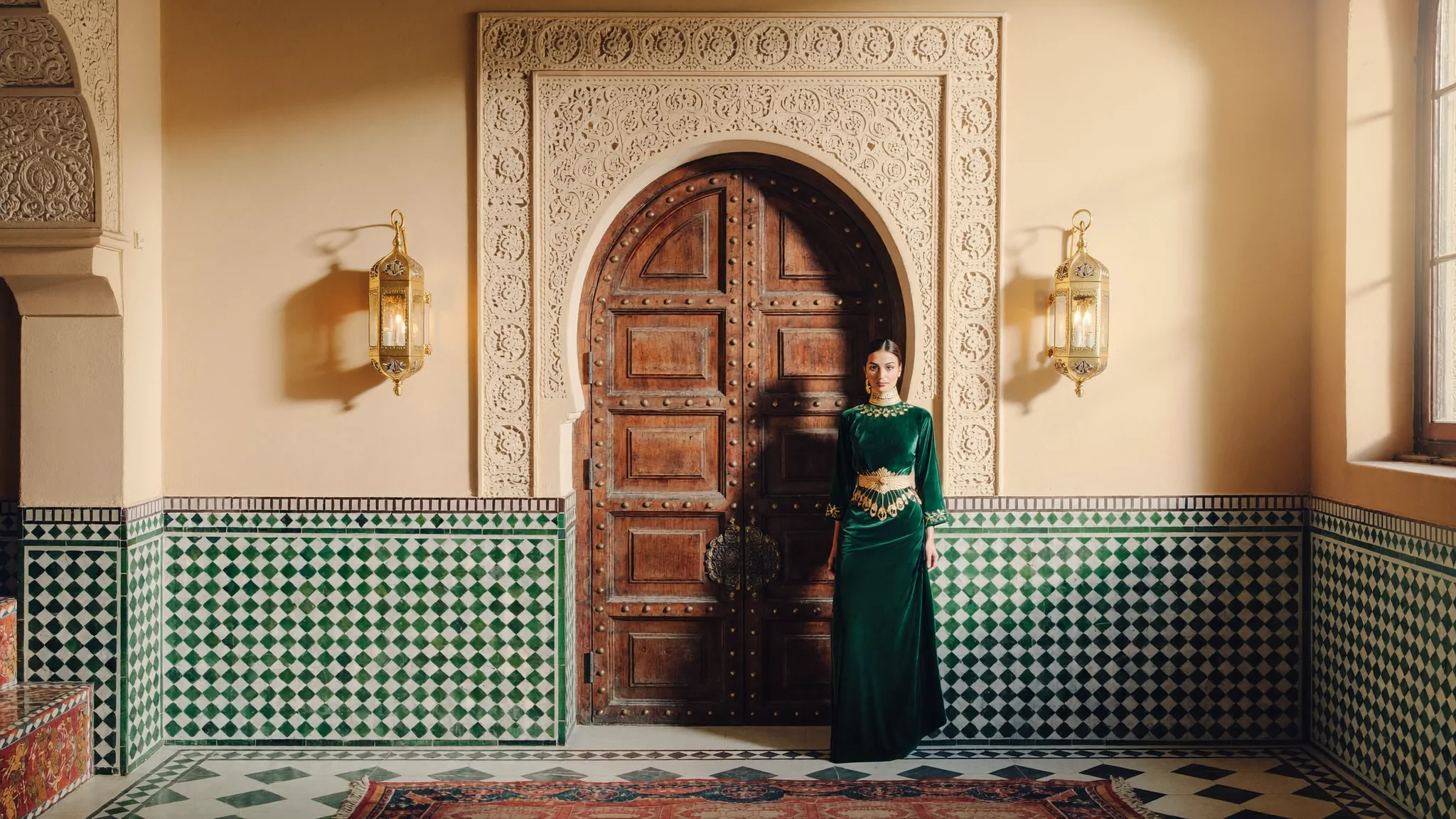
A Moroccan kaftan (qaftan) is a long, loose robe with long sleeves, worn by Moroccan women at weddings, Eid and family celebrations. It is usually cut from silk, velvet, brocade or crepe and finished by hand with sfifa braid along the seams and a row of knotted aakad buttons down the front.
What is the difference between a kaftan and a takchita?
A kaftan is a single garment. A takchita is two layers: an under-dress called the tahtia and a lighter or sheer over-dress called the dfina, held at the waist by a belt called the mdamma. Takchitas are the classic dress of Moroccan weddings.
Where does the Moroccan kaftan come from?
The kaftan was established at the Moroccan royal courts by the Saadian era in the 16th century. Over the following centuries the workshops of Fès, Rabat, Salé and Tétouan each developed their own cuts and embroidery styles.
What are sfifa and aakad?
Sfifa is a narrow braided trim made by hand from silk or metallic thread and stitched along every seam and opening of a kaftan. Aakad are small knotted buttons, tied one by one, that close the front from the neckline to the waist. Both are signs of a hand-finished piece.
How do I choose my kaftan size?
Hiba sizes use European numbers from 34 to 48. Choose the size you wear in dresses; if you are between two sizes, choose the larger one. Hiba adjusts the fit for free before shipping when you send your measurements.
Does Hiba ship Moroccan kaftans worldwide?
Yes. Hiba ships purchases from Morocco, tracked and insured, to more than 40 countries in Europe, the Gulf, North America and beyond. Delivery takes 3 to 10 business days after dispatch depending on the destination, and duties are shown at checkout where the destination allows it.
Can I rent a Moroccan kaftan instead of buying one?
Yes, inside Morocco. Hiba rents kaftans and takchitas in Casablanca, Rabat, Marrakech, Fès, Tangier and Agadir for up to four days around your event. The piece is delivered pressed two days before, fitted with you, and collected the day after; a refundable deposit is released within three days.
How do I pay for a kaftan at Hiba?
By card in one step: Visa, Mastercard, American Express, Apple Pay or Google Pay on a secure Stripe checkout. Card details never pass through Hiba’s servers.
How should I care for a silk or velvet kaftan?
Have it dry-cleaned by a cleaner who handles embroidery, never machine-wash it, and store it on a padded hanger in a breathable cotton cover away from sunlight. Steam velvet from the inside rather than ironing it, so the pile and the gold thread stay intact.
Glossary of the Moroccan kaftan
- Kaftan (qaftan)
- A long robe with long sleeves, the formal dress of Moroccan women.
- Takchita
- A two-layer outfit: tahtia under-dress plus dfina over-dress, belted with an mdamma.
- Tahtia
- The under-dress of a takchita.
- Dfina
- The over-dress of a takchita, often sheer, embroidered or lighter than the tahtia.
- Mdamma
- The belt that cinches a kaftan or takchita at the waist, in gilt metal or embroidered fabric.
- Sfifa
- Hand-braided trim of silk or metallic thread stitched along seams and openings.
- Aakad
- Small knotted buttons that close the front of a kaftan.
- Tarz
- Embroidery. Tarz fassi, tarz rbati and tarz tetouani are the main city styles.
- Randa
- A fine needle-lace edging used at necklines and cuffs.
- Negafa
- The wedding dresser who prepares the bride and manages her outfit changes through the night.
- Maâlem
- A master craftsman; in kaftan making, the master tailor who cuts and finishes the piece.